

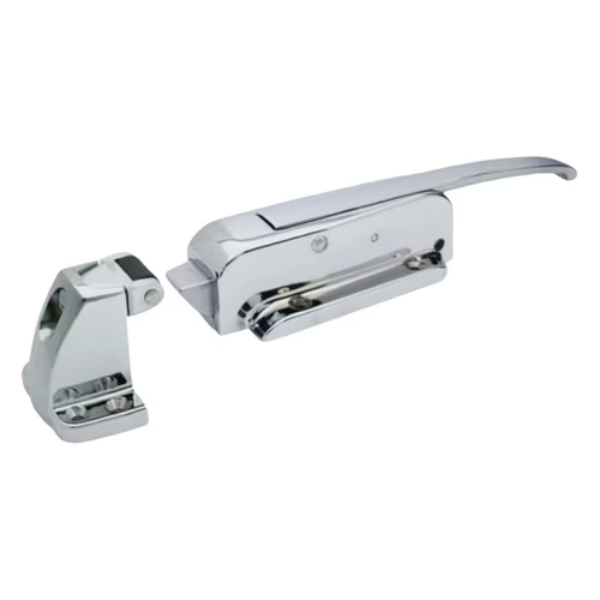
Cold room doors must close securely while allowing safe, convenient access for staff. Locks and hinges carry the door’s weight, maintain alignment, and help the gasket create an effective seal. When these components wear out, warm air and moisture can enter the room, increasing frost formation and refrigeration load.
Mahesh Refrigeration Company provides cold room door locks, hinges, and related refrigeration components for commercial and industrial users. Identifying early signs of hardware failure can help businesses replace damaged parts before the door or insulated panel suffers further damage.
Warning Signs of a Failing Door Lock
A lock or latch should pull the cold room door firmly against its gasket without requiring excessive force. Replacement or adjustment may be necessary when:
- The handle feels loose or unstable
- The latch does not engage properly
- The door opens unexpectedly
- Staff must lift or push the door to lock it
- Internal release mechanisms do not operate smoothly
- The mounting plate has shifted
- Corrosion or cracks are visible
Cold room locks should support safe opening from the inside where the application requires an internal release. Safety features must remain functional and should never be obstructed.
How Worn Hinges Affect the Door
Hinges support a heavy insulated door through thousands of opening and closing cycles. As hinge components wear, the door may drop or become misaligned.
A sagging door often produces uneven gasket contact. The upper area may appear closed while a gap remains near the lower edge. This allows humid air to enter, contributing to condensation, ice formation, and longer compressor operating cycles.
Repeatedly forcing a misaligned door can damage the lock, gasket, frame, or insulated panel.
Cold Room Door Hardware for Chandigarh Tricity Businesses
Restaurants, hotels, supermarkets, dairies, food processors, pharmaceutical facilities, and warehouses across Chandigarh, Mohali, and Panchkula rely on cold rooms for temperature-sensitive storage.
Frequent door movement and North India’s warm ambient conditions place additional pressure on door hardware. Even a relatively small sealing gap can increase heat and moisture entry during summer. Regular inspection is therefore particularly important for high-traffic facilities.
Repair, Adjustment, or Replacement?
Loose mounting hardware may sometimes be corrected through proper tightening and realignment. However, a cracked hinge body, damaged spindle, distorted latch, or badly corroded component generally requires replacement.
Adjustment may be appropriate when the hardware is structurally sound but the door has moved slightly. Replacement becomes the better option when wear prevents reliable operation or when the safety release is compromised.
What to Check Before Ordering
Cold room door hardware is not universally interchangeable. Before buying a replacement, note:
- Door thickness and dimensions
- Left-hand or right-hand opening
- Hinge position and mounting pattern
- Existing screw-hole spacing
- Lock or latch configuration
- Door weight
- Required internal release feature
- Operating temperature
- Material and corrosion resistance
Clear photographs, measurements, and the old component can help with identification. The replacement should match the door design rather than being modified forcefully during installation.
Installation Readiness Checklist
Before fitting new hardware, inspect the door panel, frame, gasket, and mounting points. Weak or damaged mounting areas may prevent the new hinge from remaining secure.
After installation, confirm that the door moves smoothly, sits evenly against the frame, and closes without excessive force. The gasket should make continuous contact around the perimeter. Staff should also test the internal release mechanism.
Dependable locks and correctly aligned hinges help preserve cold room temperature, reduce unnecessary refrigeration load, and improve workplace safety.
For suitable cold room locks and hinges, speak with Mahesh Refrigeration Company today.