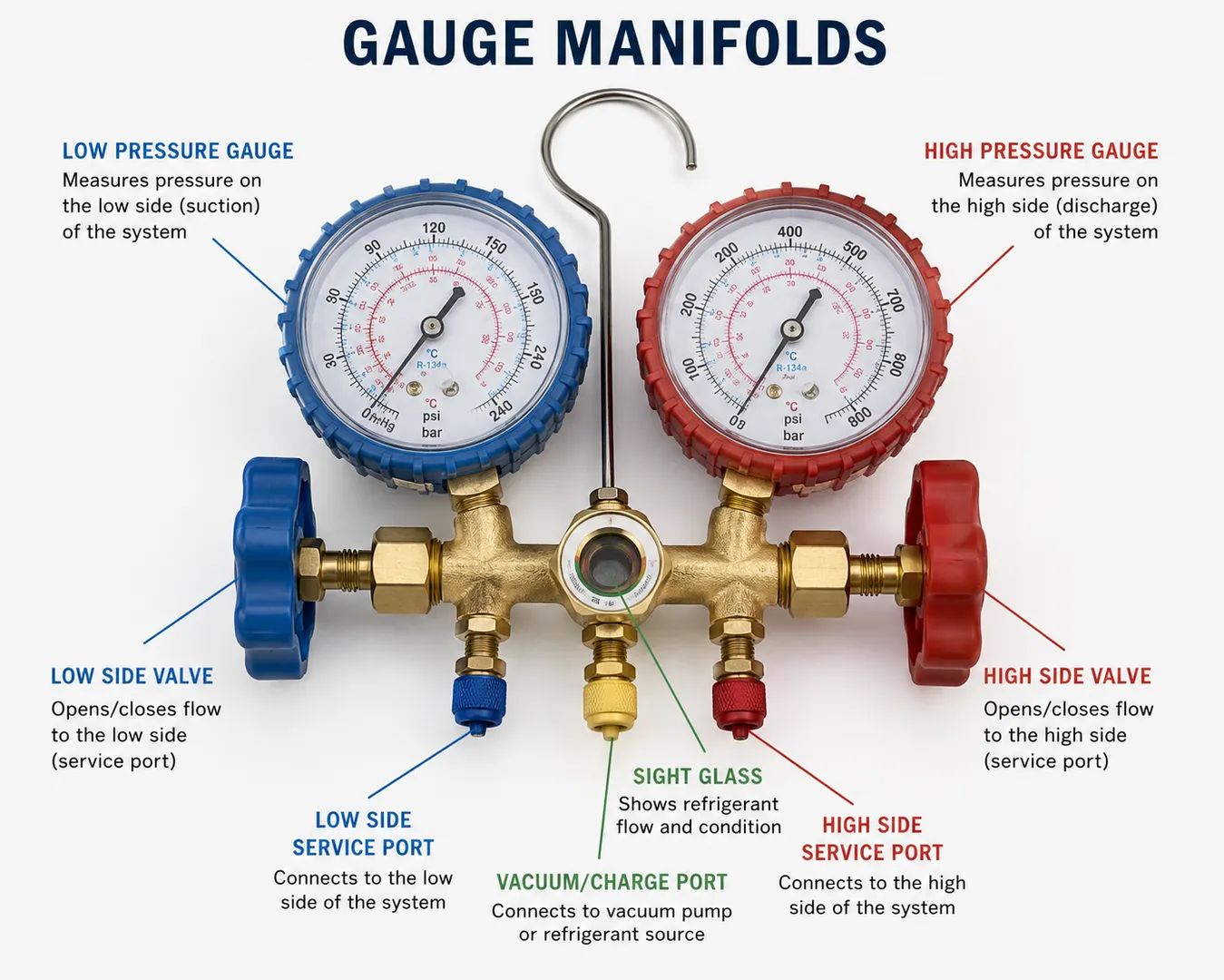
Gauge manifolds are essential diagnostic and servicing tools for air-conditioning and refrigeration technicians. They help measure suction and discharge pressures, monitor evacuation, assess system performance, and control refrigerant flow during charging or recovery. However, not every manifold set is suitable for every refrigerant or application.
Mahesh Refrigeration Company supplies refrigeration tools and components for technicians, contractors, workshops, and maintenance teams. Before selecting a gauge manifold, buyers should compare its pressure range, refrigerant compatibility, construction quality, hose specifications, and intended use.
Analogue and Digital Gauge Manifolds
Analogue gauge manifolds use mechanical pressure gauges with colour-coded dials. They are widely used because they are straightforward, durable, and suitable for routine service work. Experienced technicians can quickly interpret pressure readings, provided the gauges are calibrated correctly.
Digital manifolds offer electronic pressure readings and may include temperature probes, automatic superheat and subcooling calculations, vacuum measurement, and stored refrigerant data. They can save time during detailed commissioning and troubleshooting, but require proper handling, battery maintenance, and periodic calibration.
The appropriate choice depends on the type and frequency of work. An analogue set may be practical for general servicing, while a digital manifold can be useful for technicians handling multiple refrigerants and performance assessments.
Two-Valve and Four-Valve Manifold Sets
A two-valve manifold generally includes high-pressure and low-pressure valves, along with connections for service hoses. It is suitable for many routine charging and diagnostic tasks.
A four-valve manifold provides additional control and separate paths for refrigerant, vacuum, or recovery operations. It may reduce the need to disconnect hoses during servicing, helping limit refrigerant loss and air entry.
More valves do not automatically make a manifold better. A technician should select the configuration that matches the required service process.
Selecting Gauge Manifolds in Chandigarh Tricity
Technicians working across Chandigarh, Mohali, and Panchkula may encounter domestic air conditioners, commercial cold rooms, display freezers, chillers, and industrial refrigeration systems. A manifold intended for a split AC may not have the pressure range required for every commercial application.
High ambient temperatures during the summer can also increase operating pressures. The gauge range should allow safe and readable measurements without continuously operating near its maximum limit.
Check Refrigerant Compatibility
Refrigerants operate at different pressures and may use different service connections. A manifold designed for an older refrigerant should not be assumed suitable for a newer high-pressure or flammable refrigerant.
Before purchasing, verify:
- Supported refrigerants
- Maximum working pressure
- Burst pressure rating
- Hose connection size
- Seal and gasket compatibility
- Temperature scale and pressure markings
- Suitability for vacuum measurement
Dedicated tools should be used for flammable refrigerants to reduce contamination and safety risks.
Evaluate Hoses and Fittings
Service hoses must withstand the system’s operating pressure and remain flexible enough for practical field use. Inspect the crimped ends, seals, connectors, and hose surface regularly. Damaged, hardened, or leaking hoses should be replaced.
Low-loss fittings can reduce refrigerant release when hoses are disconnected. Hose length also matters: excessively long hoses increase internal volume and may affect charging accuracy.
Avoid Common Selection Mistakes
A frequent mistake is choosing a manifold only by price. Poor gauge accuracy, leaking valve stems, weak connectors, and unsuitable hoses can lead to incorrect diagnosis or refrigerant loss.
Another error is using the same set for incompatible refrigerants without proper cleaning. Cross-contamination can affect system performance and compromise recovered refrigerant.
A suitable gauge manifold should provide accurate readings, reliable valve control, and safe pressure handling. Matching the set to the refrigerant and application makes servicing more efficient and helps technicians reach better diagnostic conclusions.
Keywords